Vestibular physical therapy for balance, movement, and the inner ear.
Vestibular rehabilitation, balance and gait retraining, and mobility work for Parkinson's disease, stroke recovery, and concussion. Dizziness and vertigo are our largest focus and have their own program page.
Start directly — no neurology consult required. Self-referral welcome, or come with a referral from any physician.
What is vestibular physical therapy?
Vestibular physical therapy is rehabilitation focused on the vestibular system. Rather than masking symptoms, it retrains the brain's ability to process balance and motion signals — a process called vestibular compensation — through targeted, progressive exercises tailored to your specific diagnosis.
Your vestibular system — the inner-ear network that senses motion and position — works with your brain, eyes, and body to keep you balanced and oriented. When it's disrupted by injury, illness, or neurological disease, the result can be vertigo (a spinning sensation), unsteadiness, motion sensitivity, or falls.
Conditions we treat
Dizziness & vertigo
Our largest area of practice — BPPV, vestibular hypofunction, motion sensitivity, cervicogenic dizziness, and vestibular migraine.
See our dizziness & vertigo program →Balance dysfunction
Unsteadiness, fear of falling, and balance decline from vestibular disorders, neurological conditions, or deconditioning.
Post-concussion symptoms
Lingering dizziness, visual motion sensitivity, and balance problems after concussion — including symptoms that have persisted for months or years.
Parkinson's disease
Balance, gait, and mobility training to help maintain independence and reduce fall risk.
Stroke recovery
Balance and mobility rehabilitation as part of coordinated post-stroke care.
Gait & mobility
Walking speed, endurance, and confidence on stairs and uneven ground — often the difference between staying independent and not.
What actually happens in a session
1 · Evaluation
Your first visit is a thorough evaluation with your treating therapist: history, balance and gait testing, positional testing, and visual-vestibular assessment. You leave understanding what's driving your symptoms.
2 · Targeted treatment
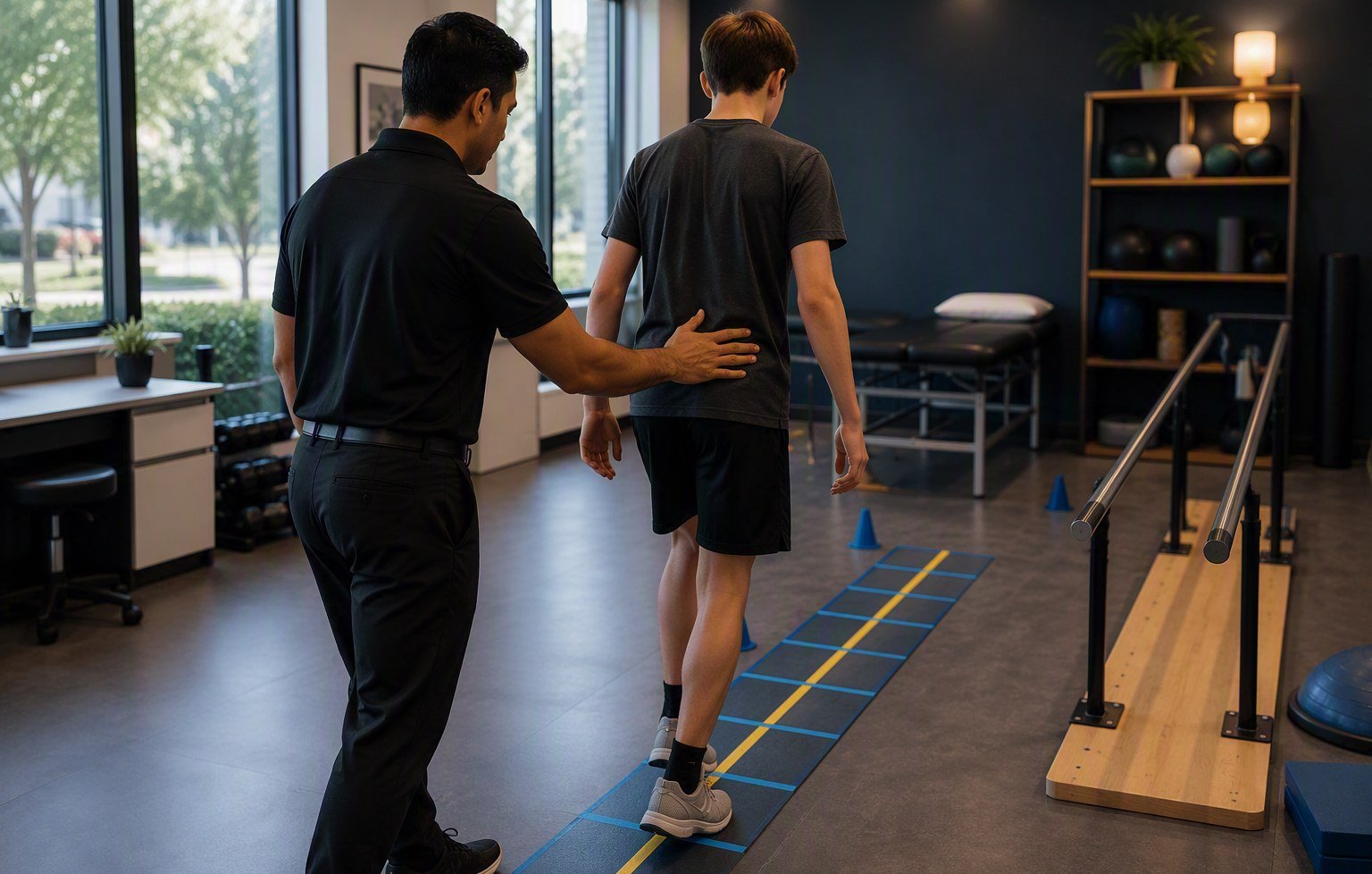
Depending on your diagnosis: repositioning maneuvers for BPPV, gaze-stabilization and habituation exercises, balance retraining, or gait work. Everything is specific — no generic exercise sheets.
3 · Progression
Your program advances as your system adapts, with a home program that makes progress continue between visits.
Two leads. Forty years of vestibular experience.
Nirav Patel, DPT
Vestibular Physical Therapy Lead20+ years treating chronic concussion, dizziness, and balance dysfunction. Co-founder of Complete Balance Solutions.
Sapan Palkhiwala, DPT
Vestibular Physical Therapy Lead20 years in vestibular disorders, balance dysfunction, post-concussion recovery, and Parkinson's disease.
Dizziness, vertigo & imbalance
Dizziness has many possible causes — BPPV, inner-ear weakness, neck-driven dizziness, vestibular migraine — and each is treated differently. Because a board-certified neurologist works in the same suite, we can tell them apart before treatment starts.
If your dizziness comes with persistent headaches or other neurological symptoms, a comprehensive neurological evaluation with Dr. Gee can run alongside your therapy — one team, one plan, one location.
Good to know before your first visit
Do I need a referral or a neurology consult first?
No. You can self-refer and start with an initial evaluation with your treating therapist, or come with a referral from any physician. No neurology consult is required to begin vestibular physical therapy.
Will therapy make me dizzy?
Some exercises intentionally and briefly provoke mild symptoms — that controlled exposure is how the brain recalibrates. Your therapist paces everything to what you can tolerate, and most people find symptoms settle as treatment progresses.
My dizziness has lasted years. Is it too late?
No. The brain's capacity to adapt doesn't expire. Long-standing symptoms can take more time and a more graded approach, but chronic dizziness and imbalance are exactly what our therapists have spent their careers treating.
How do payments work?
We're a cash-pay practice with flat fees — reviewed with you before treatment begins, no surprise fees. Superbills are available on request, and HSA/FSA cards are accepted. See Programs & Fees.
Start with an evaluation. Leave with answers.
Self-referral welcome. No neurology consult required.